Agentic AI Audit
AI agents are increasingly becoming a critical success factor for businesses, as they not only automate individual tasks but also independently orchestrate complex processes, thereby directly influencing the competitiveness, speed, and scalability of AI initiatives.
The Agentic AI Audit provides transparency into your current AI maturity and identifies bottlenecks in data, integration, and governance. It assesses feasibility and prioritizes relevant Agentic AI use cases. The result: a clear, actionable roadmap instead of isolated PoCs.
Why an Agentic AI Audit makes sense
Many companies are under pressure to quickly translate agent-based AI into tangible business results. In practice, this often results in isolated proof-of-concepts—without a clear strategy, technical validation, or integration plan. The result: The deployment of AI agents often fails due to a lack of data availability, insufficient integration, and a lack of coordination between business and IT.
The Agentic AI Audit helps you understand whether and how your Agentic AI ambitions can be implemented in your specific business context.
Your benefits at a glance
Focus on the use cases that will have the greatest business impact for you
Transparency regarding data availability and accessibility
Validation of APIs and integration options within your IT environment
Definition of KPIs and performance metrics
The process is planned and implemented step by step
Lower TCO, greater security, and improved compliance
The result
You’ll gain a clear overview of your Agentic AI readiness, including data availability, key dependencies, and technical feasibility. At the same time, risks, bottlenecks, and open questions will be identified, relevant use cases will be prioritized, and a solid foundation will be laid for future AI decisions.
Evaluation criteria for the Agentic AI Audit
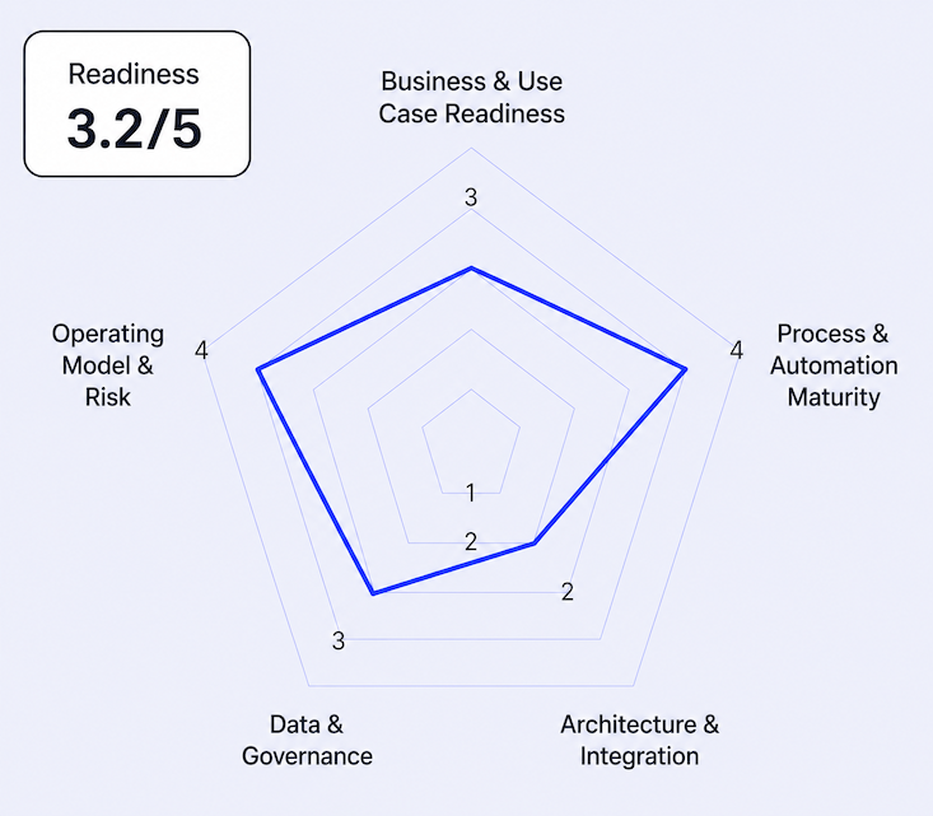
In our audit, we evaluate your organization across five key dimensions: business, processes, architecture, data, and operating model. Each dimension is analyzed in a structured manner and mapped onto a maturity model.
The result: a visual Agentic AI Readiness Spider Map that clearly illustrates your current status and identifies specific areas for action.
Here are the steps we'll follow
Preparation
Preliminary assessment by dimension as a basis for a focused and informed discussion
Workshop 1 – Current Situation
Joint assessment of your current situation, identification of opportunities and open questions
Validation
Clarification of critical issues and validation of key assumptions
Workshop 2 – Vision
Calibrating the results and deriving realistic development goals for each dimension
Documentation
Compiling and analyzing all findings to establish a clear basis for decision-making - including specific recommendations for the next steps
Pricing
A comprehensive assessment of your AI readiness
Visual Agentic AI Readiness Spider Map (strengths, weaknesses, target state)
Identification of specific areas for action
Prioritized next steps for the further development of your Agentic AI initiatives
FAQ - Frequently asked questions about the Agentic AI Audit
The Agentic AI Audit is a structured analysis designed to assess a company’s AI maturity in the context of agent-based AI systems. The goal is to provide transparency regarding data infrastructure, architecture, processes, and governance. Rather than receiving abstract advice, companies receive a concrete assessment of the feasibility of AI use cases, as well as a prioritized roadmap for successful implementation.
The audit is designed for companies that have already implemented initial AI initiatives or proof-of-concepts and now want to take the next step toward scaling up. It is particularly relevant for organizations that wish to strategically embed AI but face uncertainties regarding data availability, technical integration, or organizational implementation.
Unlike isolated proof-of-concepts or purely conceptual workshops, the Agentic AI Audit focuses on a company’s overall system capabilities. It examines not only individual use cases but also the structural prerequisites for scaling - including data, architecture, operating model, and governance. The result is an actionable roadmap rather than isolated initiatives.
The audit provides a structured assessment of your AI readiness, an Agentic AI Readiness Spider Map, and a prioritized list of relevant use cases. You will also receive a clear assessment of risks, technical dependencies, and organizational gaps. The result is a solid foundation for making decisions regarding your AI roadmap.
The process consists of five steps: preparation, an initial status quo workshop, validation of critical assumptions, a target state workshop, and final documentation. This ensures that both business and IT perspectives are integrated and that the results can be implemented immediately.
The audit evaluates five key areas: business, processes, architecture, data, and operating model. Each area is analyzed using a maturity model. This structured approach makes it possible to systematically identify bottlenecks and opportunities and to develop targeted measures.
As part of the audit, potential AI use cases are evaluated based on their feasibility, data availability, and business impact. This results in a clear prioritization of which use cases should be implemented first in order to achieve maximum value with minimal risk.
The audit mitigates common risks such as misguided investments in non-scalable proof-of-concepts, lack of data availability, or integration issues with existing IT systems. It also provides clarity on governance and compliance requirements, thereby preventing projects from being terminated prematurely.
The duration depends on the complexity of the organization, but typically includes several structured workshops as well as a preparation and documentation phase. The goal is to create a solid and actionable basis for decision-making for your AI roadmap within a short period of time.
In contrast to purely internal assessments, the audit provides a structured, methodical, and external perspective. This helps uncover blind spots, validate assumptions, and enable an objective evaluation of AI maturity. As a result, organizations can make faster, more confident, and strategically sound decisions.
Prepare your company for Agentic AI
Move from isolated experiments to a scalable, production-ready roadmap. Start with the Agentic AI Audit — for clear insights, prioritized actions, and measurable business impact.