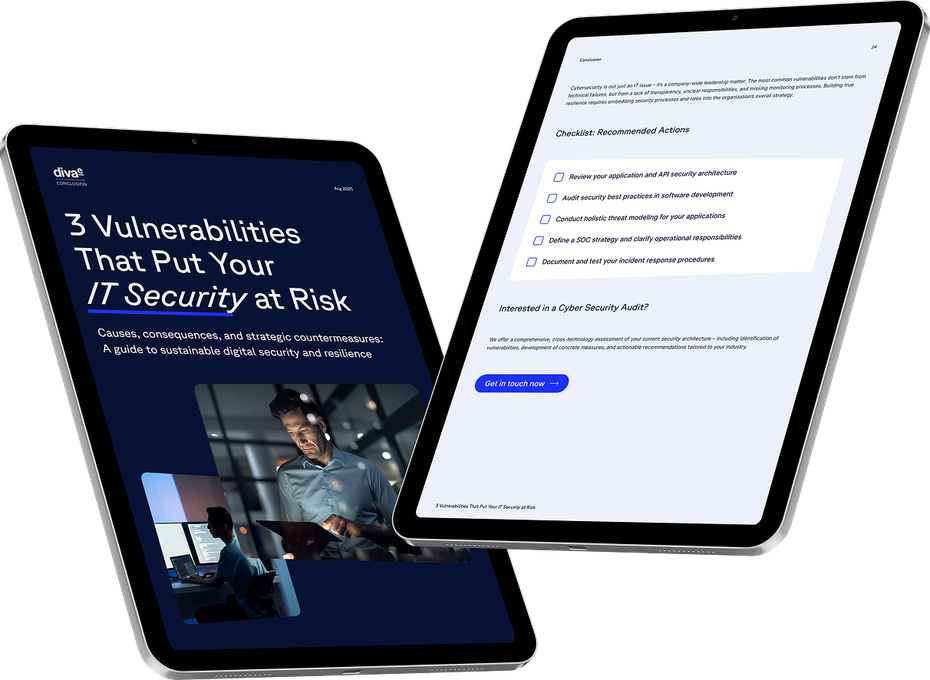
3 Vulnerabilities That Put Your IT Security at Risk
Causes, consequences, and strategic countermeasures: A guide to sustainable digital security and resilience
Cybercrime has become one of the biggest business risks today. In 2024 alone, cyberattacks caused economic damage of over €266 billion in Germany (Bitkom). What’s particularly concerning: major losses often result not from sophisticated attacks, but from internal security gaps.
This guide outlines the three most common vulnerabilities that frequently lead to serious incidents – including real-world examples and actionable takeaways for your organization.
Insights to help you sustainably strengthen your cyber resilience:
Practical risk analyses based on real-world cases
Concrete recommendations for action
Checklist: Recommended steps for maximum IT security
Frequently Asked Questions (FAQ)
The Cybersecurity Guide covers key aspects of application security and the protection of digital systems. It explains common threat scenarios, security risks, and fundamental protection mechanisms. The focus is on building a structured understanding of cybersecurity in the context of modern digital applications. The goal is to clearly classify security requirements.
The guide is aimed at decision-makers, IT managers, developers, and product owners. It is relevant for organizations that operate, develop, or further evolve digital applications. Roles responsible for security, stability, and compliance of digital systems are particularly addressed.
The guide covers application security, common vulnerabilities, threat models, and basic protection measures. It places technical, organizational, and procedural aspects of cybersecurity into context. The emphasis is on practical orientation rather than deep technical detail.
Application security is critical because applications are frequent targets of cyberattacks. Security vulnerabilities can lead to data loss, system outages, or legal consequences. A structured security approach helps identify and reduce risks at an early stage. Secure applications are a core component of stable digital business models.
Challenges arise from complex system landscapes, time pressure in development processes, and missing security standards. Coordination between development, operations, and organizational units can also be difficult. In addition, threats continuously evolve, requiring regular adjustments.
The guide provides orientation on fundamental security principles and common vulnerabilities. It helps organizations better understand and structure security requirements. This enables more targeted planning and prioritization of security measures. The focus is on a holistic security perspective.
Cybersecurity is not only a technical but also an organizational responsibility. Clear processes, defined responsibilities, and security awareness are essential for effective protection. The guide positions cybersecurity as an integral part of development and operational processes.
The Cybersecurity Guide is available as a PDF document. It is structured as a text-based resource offering a concise introduction to key aspects of application security. The content is suitable for independent reading and internal knowledge sharing.